Skip to content
Center for Pastoral Renewal
  • Home
  • About Us
  • Books
  • Blogs
  • Podcast
  • Publications
  • Resources
  • Contact Us

Home » Blogs

Blogs

Burnout

On Pastoral Burnout, Spiritual Disciplines, and Other Vocational Risks

It is important to make a couple of distinctions when considering pastoral burnout. There are three main conceptual categories related to pastoral depletion. First, spiritual abuse is a trauma related experience. Sometimes pastors experience spiritual abuse from their congregations (and vice versa) which is sometimes described as burnout due to the empty feelings associated with it. Not only could it result in a spiritual type of depression and emptiness due to harm, but it could also be expressed in trauma symptoms like dissociation, experience of stress reactions, and heightened vigilance.

Second, pastoral burnout is different from burnout in other vocations. Pastoral burnout is the manifestation of spiritual depletion. Pastors empty themselves in ministry – empty themselves to their flocks and families. Without spiritual replenishment, spiritual depletion leads to burnout. Our work includes focus on the location of pastoral work – the church and family. Both these contexts are important in depleting the spiritual health of the pastor. These contexts are also crucial in supporting the health of the pastor. Intervention focused on pastoral burnout needs to consider three things – the person of the pastor, the church, and the family.

Third, pastors also experience compassion fatigue, like psychotherapists. Compassion fatigue means that pastors experience depletion and fatigue due to shepherding the flock. As part of visitation, pastoral counseling, and other human facing obligations, pastors expend psychological energy walking alongside congregants. Expending this energy may result in depletion of psychological resources for the pastor.

For all these experiences, a spiritual response is required. Spiritual disciplines are key to prevention and recovery. We recommend pastors to begin with basic practices that have been meaningful on the past. Start slowly. Be gracious to yourself. And we talk about three levels of practice. 1. Immediate, short term. 2. Intermediate, middle level. 3. Long term. The ideal is to build long term spiritual practices that increase one’s spiritual capacity. Since that is depleted, we start slowly.

Please check out our resources on spiritual practices. https://centerforpastoralrenewal.com/resources/

Blog

Technology: A Blessing and A Curse?

Technology is in every part of our lives – that little device in your hand allows you to pray for
others, read and share Scripture, communicate with your small group members, and watch
church online. It allows you to answer parishioner emails, set calendar appointments with staff,
dictate notes for sermons, and respond to emergencies in real time. This device also allows
holds a wealth of distractions that can easily get out of hand – social media, news feeds,
games, shopping, music, gambling, and the like. It presses our worldly culture into our eyes and
ears through our screens, where one post leads to the next. It is easy for us neglect spiritual
growth, quiet times with God, opportunities for service, reading the Bible, hearing from God, and
prayer. What causes us to constantly access the apps on our phones – Work? Boredom?
Posting our lives? Validation? Comparisons with others? What would your life be like if you
decidedly put down your phone to seek Jesus? A recent article by Mutsvairo, et al. (2022, p. 89)
found that “…electronic activity is perceived both be a tool of freedom as well as a subtle form of
potential digital enslavering.”

What are your digital habits? If your brave enough, look at the amount of time you spend on
your phone in a given day. Which apps are time-wasters that do not add to your life or your
calling in Christ? The Bible states we should have self-control and discipline (2 Timothy 1:7,
Titus 1:8, 1 Corinthians 9:27), we should not be dominated by anything (1 Corinthians 6:12), and
we should not be conformed to this world (Romans 12:2). My favorite verse related to the
overuse of technology is Proverbs 25:28: “A man without self-control is like a city broken into
and left without walls.” Has technology, let’s say an app, broken through your walls? On a scale
of 1-10, how would you rate your personal use of technology for distraction? 1 is no distraction
and 10 is extreme distraction. One last question: From a technology perspective, what can you
eliminate or add to make better use of your time and efforts?

Please don’t get me wrong; I am not saying that the use of technology is bad or inherently evil.
In no way am I saying that the overuse of technology can drive us into the world or away from
Godly practices. Let’s look at how we use technology (i.e. apps, number of hours, when we use
the apps, etc). I am simply asking a question: Do you drive your use of technology or does your
technology drive you? If you are brave enough, ask your spouse or a close friend how they view
your phone/technology habits. Does something need to change?

Here are a few suggestions:
1. Take part in a digital fast with friends, small group members, or as a church.
Consider The Digital Fast Workbook: Detox Your Mind and Reclaim What Matters Most
by Darren Whitehead.
2. Track your screen time. Your phone most-likely has the feature.
3. Set daily or weekly screen time limits.
4. Create screen-free zones and times (i.e. the dinner table, the bedroom, etc.).
5. Turn off app notifications.
6. Pursue offline activities (take a walk, pray, converse with others, read a book,
pick a new hobby, etc.).

References

Mutsvairo, B., Ragnedda, M., & Mabvundwi, K. (2022). ‘Our old pastor thinks the mobile
phone is a source of evil.’ Capturing contested and conflicting insights on digital
wellbeing and digital detoxing in an age of rapid mobile connectivity. Media
International Australia, 189(1), 89-103.
doi:https://doi.org/10.1177/1329878X221090992

Caring-For-Our-Shepherds_Book_Release Uncategorized

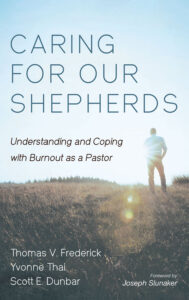
Caring for Our Shepherds Book Release

Caring-For-Our-Shepherds_bookcover

Pastors play a fundamental role in churches across the globe, yet more and
more are finding themselves struggling with the stress of ministry life and
experiencing burnout. The consequences of pastoral burnout can be severe
and impact not only individuals’ physical, mental, and emotional well-being, but spillover to their families and congregations as well. Despite this increasingly common problem, the subject of pastors and their unique experiences has not been well studied. Caring for our Shepherds is written to pastors and for pastors. In this book, researchers on pastoral burnout, Thomas V. Frederick, Yvonne Thai, and Scott Dunbar answer the questions: what is pastoral or ministry burnout, how can it be guarded against, and how can we help those experiencing it? The reader will not only develop a deeper understanding for the demands of ministry, but also be provided with specific practical and spiritual frameworks to cope with those demands in ways that promote a positive and healthy mindset. Caring for our Shepherds is an excellent resource not only for those in ministry, but to those who desire to pour back into those who serve in the church.


Center for Pastoral Renewal Team
photo credit: bycphotography

Q&A With the Authors

What was your motivation for writing this book?

Thai: Years ago, I lost the lead pastor of our church to suicide, and this was the motivation and driving force for our team to pour ourselves into researching and publishing on pastoral burnout, a topic that we would come to find was not well studied.

Dunbar: Yeah, in the years we have spent talking with pastors, pastoral staff, and ministry leaders, we have learned about the unique stressors associated with pastoring and ministering.

Frederick: This is why we founded the Center for Pastoral Renewal and, in part, why we wrote this book. Our book is based on our psychological research on coping with pastoral burnout. In it, we provide Christian spiritual resources to deal with the distinctly spiritual nature of pastoral burnout.

What qualifies you to write on this topic?

Dunbar: We hold doctorates in our respective fields and are tenured professors at California
Baptist University. Our disciplines span across Psychology, Theology, Sociology, and Business.

Frederick: Together we have published multiple chapters, empirical research studies, and books on
the topics of burnout, spirituality, work-life balance, and emotional well-being. We have also presented our research findings and publications at academic conferences and continue to conduct peer-reviewed
research studies.

Thai: Also, we have spoken at pastoral conferences and trainings and partnered with ministries overseeing
pastoral care. It is very important to us to be able to speak directly to the pastorate and church leaders
because they are the population we are trying to serve.

What is this book about?

Frederick: Pastors play a fundamental role in churches across the globe, yet more and more are finding
themselves struggling with the stress of ministry life and experiencing burnout.

Dunbar: Right, the consequences of pastoral burnout can be severe and impact not only individuals’
physical, mental, and emotional well-being, but spill over to their families and congregations as well.
Frederick: Despite this increasingly common problem, the subject of pastors and their unique experiences has not been well studied.

Thai: In this book, we answer the questions: what is pastoral or ministry burnout, how can it be
guarded against, and how can we help those experiencing it.

Frederick: The reader will not only develop a deeper understanding for the demands of ministry, but also
be provided with specific practical and spiritual frameworks to cope with those demands in ways that
promote a positive and healthy mindset.

What is unique about this book when compared to other books on this topic?

Frederick: Caring for our Shepherds is unique in that it combines three important aspects of Christian
pastoring. First, our book is based on our psychological research on coping with pastoral burnout.
Second, our book describes the importance of calling, specifically tied into our identity in Christ, as a
resource for pastors dealing with burnout. Finally, we provide Christian spiritual resources to deal
with the spiritual nature of pastoral burnout. Specifically, since pastoral burnout is primarily a spiritual
issue, we present Christian spiritual practices as a means to reinvigorate the spiritual depletion aspect of
pastoral burnout.

Who should be reading this book?

Thai: This book is written to pastors, for pastors, and to those who care about pastors. It speaks directly
to the unique stressors and demands pastors experience in their roles and the consequences that they face.

Frederick: The book provides spiritual and psychological resources to cope with stressors leading to
burnout. It is also intended for ministry and church leaders and those who support them in these roles.

Where can your readers go for more resources and to learn more about this topic?

Dunbar: Readers who are interested on the topic of pastoral support and care can find more resources at
our website: https://centerforpastoralrenewal.com/

Frederick: Here they will find self-assessment tools, additional recommendations for resources, our podcast featuring pastors across the nation, and blogs on issues related to pastoral support and care.

Thai: They can also connect with us on Instagram. Our handle is: @centerforpastoralrenewal. Please
consider following us to hear more from pastors across the nation. We would love to form a community
for pastors, ministry, and church leaders to connect with us and with each other!


Praise for “Caring for Our Shepherds: Understanding and Coping with Burnout as a Pastor”

“Caring for Our Shepherds is a clearly written and very helpful book on understanding and coping with
burnout as a pastor. Frederick, Thai, and Dunbar provide practical ways of managing pastoral burnout,
including spiritual disciplines and four Christian devotional meditation practices of lectio divina, the Jesus
Prayer, centering prayer, and the examen. Highly recommended!”
— Siang-Yang Tan, senior professor of clinical psychology, Fuller Theological Seminary

“This book provides a practical conceptual overview of understanding the unique aspects of ministry
burnout and how to care for those experiencing it. The authors provide practical ways for spiritual
disciplines to be developed in a minister’s lifestyle to enhance their personal and ministry health. The
reader will discover a pathway to respond to their own ministry struggles as well as help others within their circle of influence.”
— Roger A. Yancey, executive director, Tryon Evergreen Baptist Association

“Mindfully constructed for the busy and burdened pastor with direct, insightful information and practical
steps, Caring for Our Shepherds is a necessary read for all pastors in ministry.”
— Cody Bockelkamp, biblical counselor

Being Thankful at Thanksgiving Blog

Being Thankful at Thanksgiving

The holidays are fast approaching! In this blog post we will look at being thankful and grateful in a
season that may be fraught with anxiety, increased workloads, longer hours, higher expectations, and
more time with people. Let’s get into a mood of thankfulness through Scripture: Psalms 107:8-9 states,
“Let them give thanks to the Lord for his unfailing love and his wonderful deeds for mankind, for he
satisfies the thirsty and fills the hungry with good things.” 1 Thessalonians 5:18 states that we are to
“Give thanks in all circumstances; for this is God’s will for you in Christ Jesus.”

I am reminded of the song the Carpenters made famous – There’s No Place Like Home for the Holidays.
Do you think of your childhood Thanksgivings? Do you think of family responsibilities? The financial
costs? Time with family members that you may or may not want to spend time with? Society makes a
pointed turn to reminisce about the good old days of being at home with our loved ones. However, our
greatest source of pain, and our greatest source of love, is the family.

The church is expected to fill this role as the family of God. Unfortunately, the church is also a source of
great love and joy – and pain and hurt and sadness. Pastors and church members often have high
expectations about what the church should be or do as God’s family, and disappointment happens when
these expectations are not met.

Consider that Thanksgiving Day and the days prior to Thanksgiving can be stressful. I encourage you to
make a list of the things in life for which you are thankful. Your list may include aspects such as
salvation, parishioners, family members, home, health, work, friends, co-workers, food, etc. What
would add to this list?

Next, consider the causes of anxiousness or disagreements that occurred during past holidays. You
know, the holidays in which we are supposed to be extra thankful? Did you have more parishioners
share their problems during this season than usual? Did you find it hard to say ‘no’ because you felt a
sense of duty to shepherd the individuals in your flock? Pastors who are continually exposed to the
troubles of others may experience compassion fatigue, which can lead to anxiety, lack of purpose,
emotional disconnection, physical symptoms such as headaches and stomachaches, exhaustion, and
difficulties with personal relationships (Psychology Today, 2023) . Additionally, pastors may have
experienced anxiousness when trying to balance work and home expectations. Such past issues may
cause you to feel stressed, anxious, and even unthankful as we head into Thanksgiving.

Now that we have a list of positives (things for which we are thankful) and a list of negatives (past
causes of stress and anxiety), let’s use them to prepare for this year’s Thanksgiving. Below are a few
ways to increase your thankfulness and gratitude, while minimizing past causes of Thanksgiving stress:

 Be aware of compassion fatigue as you listen to the issues and traumas experienced by
parishioners. Over-empathizing can lead to the negative consequences associated with
compassion fatigue.

 Setting expectations with parishioners before the Thanksgiving holiday: “Guest Pastor Bill will be
speaking while I am away with family this Thanksgiving weekend.”

 It’s okay to delegate! Plan for specific individuals to assist you with parishioner requests.

 Repeating Scripture can help you relax. My favorite verse is Philippians 4:4-7 “Rejoice in the
Lord always. I will say it again: Rejoice! Let your gentleness be evident to all. The Lord is near. Do
not be anxious about anything, but in every situation, by prayer and petition, with thanksgiving,
present your requests to God. And the peace of God, which transcends all understanding, will
guard your hearts and your minds in Christ Jesus.”

 Create a schedule to help with work-life balance. Share this schedule with the people it affects,
such as your spouse.

Of course, the list above is not exhaustive. What would you add to the list to help yourself prepare to be
thankful and grateful, while reducing stress? As we have seen, looking back at past holidays can help us
better prepare this this year’s holidays. However, your past Thanksgiving experiences do not dictate
how this Thanksgiving will turn out. We pray you make this the best Thanksgiving and that you find joy
in all that Thanksgiving has to offer.

References

Psychology Today. (2023). Compassion Fatigue. Retrieved November 8, 2023, from Psychology Today:
https://www.psychologytoday.com/us/basics/compassion-fatigue

How are you treating others Burnout

How Are You Treating Others?

Several of our previous blog posts are related to pastoral renewal, burnout, stress, goal setting, coping strategies, etc. In this blog post we are taking a different point of view. Let’s ask ourselves this question: Are you causing others stress and burnout? If you will indulge me, I would like to share a story of how I fell into the trap of stressing-out some of my employees and how I changed my behaviors to stop this stress.

I managed a hospital staff and had a few great employees, a bunch of middle-of-the-road employees, and some employees that were below standard. I knew I could count on my few great employees to get tasks done correctly and on-time. However, I continuously assigned this small number of solid employees with additional tasks and responsibilities. Why did I do this? Simple – I knew these employees would get the job done right and on-time. I did not have this faith in the middle-of-the-road employees and not in the below standard performing employees. In other words, I made the mistake of rewarding good performing employees with more work. This caused my high performing employees stress. Additionally, the middle-of-the-road employees were missing out on growth and development opportunities. Does this story or situation resonate with you? Fortunately, I was able to change my leadership behavior before it was too late!

Pastors and church leadership can easily fall into this same trap as they are often pulled in multiple directions and are tasked with handling urgent matters. It is important to note that we can fall into this same trap with our children and church volunteers. It is easier to see our own situations (i.e. those who cause us stress and burnout), as opposed to understanding how we are affecting others. We may often lead others with good intentions; however, it may help to stand back and ask yourself about your leadership behaviors.

Here are a few questions to ask yourself:

  •  Who are your go-to employees?
    • Do your go-to employees work more hours or complete more tasks than their peers?
  • Do you continually ask your go-to employees to complete tasks that are either outside of the scope of their job duties or tasks that are urgent?
    • What are your go-to employees’ reactions (both verbal and non-verbal) when you communicate tasks to them?
    • How do you reward your go-to employees?
  • Are there employees other than your go-to employees that are missing out on growth and development opportunities?
    • Why do you avoid assigning these individuals tasks that are routinely given to your go-to employees(s)?

Research shows that high workloads create stress and time conflicts that exacerbate emergency situations. Oppositely, reduced work hours reduce stress and allow employees to recover (Barck-Holst, et al., 2021). Luke 6:31, known as the ‘Golden Rule,’ states, “Do to others as you would have them do to you.” Thinking of this Scripture, put yourself in the shoes of your go-to employees and ask yourself a few final questions:

  • Is your boss or leader causing you stress? Why or why not?
  • Do you have work-life balance?
  • Are your being rewarded fairly for your work?
  • Are you doing more than your peers?
  • What is the one thing my boss or leader could do better for me?

Answering these questions from your go-to employees’ point of view may be difficult. However, it may provide you with a better understanding of your employees. The final point I will make in helping to reduce the stress and burnout of your employees is communication. Without open and candid communication, we will not be able to fully understand the viewpoints and situations of our employees. I leave with Proverbs 12:25, which states, “Anxiety weighs down the heart, but a kind word cheers it up.” Let us lead in a way that cheers up the hearts of our employees and reduces anxiety.

Uncategorized

Intrusive Demands in Ministry and Burnout

In an age of 1-click shopping, mobile ready orders, and real-time news updates in the palm of
our hand, these are unprecedented times. As with all good things, it is necessary to consider the
bad and ugly. Perhaps one unintended consequence of an “on-demand” mentality is the
availability of pastors. While many people experience some carry-over from work life to
personal or home life, pastors are uniquely situated in a position that regularly requires them to
care for others, even when “off the clock.” Pastors are also open to scrutiny, which can involve
family members. Taken together, intrusive demands in ministry lead to burnout.

Nearly a quarter century ago, four factors emerged from the Ministry Demands Inventory that
load onto intrusive demands among clergy. Given technological advances in communication and
anonymity afforded by online reviews, one could speculate through reasoned argument that
demands have only intensified since then. The intrusive demands noted by the Ministry
Demands Inventory and studied by Lee (1999) include the following.

1. Personal criticism of the minister. Criticism comes in many different varieties.
Sometimes criticism propels the receiver forward, in the form of offering valuable
feedback. In other instances, criticism may be unhelpful or even hurtful. Pastors may
even experience abusive remarks from others. Notice that the literature states “personal”
criticism. What happens when others are personally critical of us? We might have the
tendency to become cynical of others, which is one element related to burnout (Maslach,
Schaufeli, & Leiter, 2001). Examples of personal criticism from the inventory include,
“A member questioned your devotion to the ministry” and “A member voiced doubts to
you directly about your faith” (Lee, 1999, p. 482).

2. The presumptive expectations of the minister’s flexibility and availability on the part of
the congregation. Prevailing attitudes that pastors can communicate or adjust their
schedules makes way for intrusive demands. An important note here is that some pastors
have work responsibilities in other areas, in addition to the ministry. According to
Lifeway Research (2019), 26% of pastors report being bi-vocational (having another
job—paid or unpaid—on top of their ministry role). Examples of presumptive
expectations from the inventory include, “Your sleep was interrupted by a phone call
from a member” and “You were asked to perform some ministry task at the last minute”
(Lee, 1999, p. 482).

3. Boundary ambiguity. For pastors and their families, stressors that relate to boundaries
include “issues surrounding time, mobility, congregational fit, space, isolation, and
intrusions” (Hill, Darling, & Raimondi, 2008, p. 147). Examples of boundary ambiguity
include, “A member came by your home unannounced” and You were approached by a
member in a public place, outside of church” (Lee, 1999, p. 482).

4. Criticism of the minister’s family. Colloquially speaking, pastors’ families live in
“glass houses.” This inescapable reality is likely to draw a smirk from any “PK”
(pastor’s kid). Consider some of the example prompts from the inventory. “A member
complained to you about someone in your family” and “A member raised questions about
how you or your family spend money” (Lee, 1999, p. 482).
Coping with intrusive demands

Everyone copes with intrusive demands differently. Additionally, contextual variables will
dictate appropriate preventative strategies and interventions for intrusive demands. With this in
mind, consider some of the suggestions below to help you mitigate this precipitating factor for
burnout.

1. Now that you know the predominant ways that intrusive demands occur, make a list of
your personal experiences of others demanding your time, attention, or services. Kick
boundary ambiguity in the teeth by establishing well defined boundaries. Enlist the
services of an accountability partner to help you stick with the plan.

2. Be relational with a purpose that is congruent with your identity. Differentiation of self
(DoS) sets a framework for health relationships. DoS is “the ability to maintain
relationships with others that are based on one’s core identity commitments. It describes
how one lives out one’s core values and identity commitments while engaging in
meaningful relationships” (Frederick et al., 2023). In a recent study by Frederick et al.
(2023), DoS was found to protect against personal burnout by acting as a resource.
While it is impossible to control criticisms, the company we hold as differentiated beings
may serve us well in spite of those criticisms.

3. Go to therapy. Personal criticisms that go unchecked can inform closely held beliefs
about self. Those beliefs can be internalized to create core beliefs, which inform the way
we view ourselves and the world around us. Therapy can help address core beliefs to
shape new, life-giving thoughts.

4. Pray that God would reduce the quantity and intensity of intrusive demands in your
ministry. Pray that God would give you strength and provision to continue your ministry
calling! We are praying alongside of you!

5. Cognitive therapy is often a treatment of choice when instances of negative thought
patterns predominate. One aspect of cognitive therapy includes changing our thoughts.
Reframing how we internalize messages of intrusive demands, especially those involving
criticism, may lead to healthier outcomes. For example, a former colleague told me that
one of his students was praying for him during class, instead of recognizing what was
truly going on—the student had fallen asleep. Perhaps we shouldn’t lie to ourselves,
instead can open ourselves up to alternative possibilities.

6. Be reflective rather than reactive. Sometimes simply scheduling time in our day to be
reflective about daily circumstances can offer perspective. Metacognition includes
thinking about thinking. Actively monitor the ways in which intrusive demands impacts
your thinking.

References
Frederick, T. V., Thai, Y., Dunbar, S. E., Ardito, R., Eichler, K., Kidd, K., Carrera, J., & Almero,
M. (2023). The effects of role differentiation among clergy: Impact on pastoral burnout
and job satisfaction. Pastoral Psychology, Retrieved on January 26, 2023, at
https://doi.org/10.1007/s11089-022-01052-w.

Hill, E. W., Darling, C. A., & Raimondi, N. M. (2003). Understanding boundary-related stress in
clergy families. Marriage & family review, 35(1-2), 147-166.

Lee, C. (1999). Specifying intrusive demands and their outcomes in congregational ministry: A
report on the Ministry Demands Inventory. Journal for the Scientific Study of Religion,
38(4), 477-489.

Lifeway Research. (2019). More than half of pastors started their careers outside the church.
Retrieved on January 26, 2023, at https://research.lifeway.com/2019/01/11/more-than-
half-of-pastors-started-their-careers-outside-the-church/.

Maslach, C., Schaufeli, W. B., & Leiter, M. P. (2001). Job Burnout. Annual Review of
Psychology, 52(1), 397-422.

Guest author: Brent Moore, PhD, LCPC

2023 Goals Uncategorized

Developing Spiritual Goals

Now that the new year is beginning and the business associated with this time is passing, perhaps it is a
good space to begin identifying goals for the new year. Did you set goals last year? If so, were you
successful in achieving your goals? My wife and I sit down each year and write goals for the upcoming
year. We have categories such as marriage, kids, finances, work, and spirituality. To be honest, we set
these goals and tend to lose track over time. The focus of this blog is developing spiritual goals with the
intent of continued follow-up throughout the year. Let’s start with how to set goals.

I have found the best way to set goals is through the S.M.A.R.T. goals concept. The acronym stands for
Specific, Measurable, Attainable, Realistic, and Timebound. Specific can be thought of as being exact
and clear-cut; measurable means that the goals can be quantified; attainable means that you can
achieve the goal; realistic means that goal is within reach; and timebound ensures there is an end date
or ending time of the goal. Let’s see how this works out for a common goal – losing weight.

We might have a goal of losing weight at the beginning of the new year. How would this goal look using
the S.M.A.R.T. goals concept? I want to lose 5 pounds by May 1 st of this year. Losing 5 pounds is
specific; measuring your current weight and subtracting weight makes this measurable; understanding
my height, current body weight, diet, exercise routine, etc. makes this attainable within the timeframe;
losing 5 pounds is within reach (a goal of losing 25 pounds may seem great, but it may not be within
reach in the given timeframe); and the end date of May 1 st ensures the goal is time sensitive in nature. I
can set milestones to see if I am making progress towards achieving this goal. For example, half-way
through the goal, February 14th, I should have lost 2.5 pounds. Breaking our goals into manageable
chunks helps us to achieve and celebrate mini-milestones; this also keeps us motivated. Now that we
understand S.M.A.R.T. goals, how can we apply this to creating and achieving spiritual goals?

Another way to think about this goal is becoming more Christlike. That is, our spiritual goal is to
ultimately feel and act like Jesus. Spiritual goals help us to grow closer to God, better serve others in
His kingdom, to bear fruit, and become more of the person God created us to be. Do you have spiritual
goals for this year? If so, continue. If not, I recommend taking time to pray and fast with the intent of
learning what goals God has for you this year. The fruit of the Spirit found in Galatians 5:22-23 which is
a great place to start when thinking about spiritual goals. The fruit of the Spirit are love, joy, peace,
patience, kindness, goodness, faithfulness, gentleness, and self-control. Is God wanting you to grow in
any of these areas? Titus 1:5-9 is another great place to start when looking to set spiritual goals. These
passages talk about the qualities of church elders or church leaders. Examples of these qualities include
being above reproach, not being arrogant, not having a quick temper, and not being violent. James
1:19-21 can also help us create spiritual goals. These verses speak of being quick to listed, slow to
speak, and ridding oneself of moral filth. Lastly, I recommend speaking with those that are closest to
you and asking them for potential areas of spiritual growth. Be careful with this suggestion, as it
requires honesty and a thick skin! Do not start this conversation if both parties are not 100% ready.
Let’s look at creating a S.M.A.R.T. goal related to self-control – creating work and home boundaries.

Serving parishioners is part of a Pastor’s role. However, you may feel the need to respond to all
requests at all times of the day. Let’s create a S.M.A.R.T. goal related to work boundaries: “I will not
check work emails or text messages from 5:30 pm – 7:00 am on workdays and not on my days off.” This goal is specific as it refers to emails and texts only. This goal is measurable. A simple measurement
would be recording the number of times you checked work-related emails and texts during the
designated down times. This goal is attainable, although an outgoing auto-response may be necessary
(i.e., “I am away from the office at the moment, but I will respond tomorrow morning. If this is a true
emergency, please contact Pastor Smith.” Only you will know if the goal is truly attainable. The goal is
within reach/realistic. As with the attainable component, only you will know if this goal is realistic based
upon your role and responsibilities. Lastly, this goal is bound by times; The time period of 5:30 pm –
7:00 am and the additions of workdays versus days off makes the goal time-bound. This goal is only an
example and should not be used without considerations for your specific role and expectations. Such a
goal should be discussed with your boss and family prior to starting.

There is one essential steps after setting your spiritual goals – accountability. Share your spiritual goals
with your spouse, or another person who has the strength and integrity to hold you accountable. In our
previous weight loss example, having a gym partner will help me get to the gym regularly. Additionally,
including the person who does the grocery shopping and cooking in your household, if this is not you,
can help you achieve your goals through a proper diet. Lastly, celebrate your goals! If you are on track
and meeting your mini-milestones, celebrate! Share with your successes with your accountability
partners. Also, share if you are not meeting your mini-milestone, as your accountability partners can
offer encouragement and offer ways to get you back on track. Lastly, include God in every step. Your
spiritual goals should center on His will for your growth. He loves you and wants the best for you!

Changing our focus to others Coping

Changing Our Focus to Others

Previously we looked at coping with pastoral stress and burnout through The Jesus Prayer. The Jesus
Prayer, coupled with the intentional breathing patterns, allows us to cope with stress and burnout in the
moment. Another way to battle stress and burnout in the moment is through a different type of prayer.
The type of prayer focused on in this blog is prayer for others. This is a change in mindset as we typically
pray for ourselves, our issues, our specific situation, etc. when we feel stressed-out. In other words, we
call out to God to help us in our circumstances. There is nothing wrong with praying for ourselves. Let’s
change direction from ourselves for a moment: How can praying for others when you are feeling
stressed-out help you cope in the moment?

Praying for others we know has proven mental and physical positives outcomes. People that pray for
one another, especially in exclusive romantic relationships, expressed increases in commitment and
relationship satisfaction. That is the power of prayer indeed. In other words, couples that pray for one
another stay together! (Fincham, et al., 2014). The benefits of prayer are also focused on medical
challenges. Individuals with HIV who prayed for those they knew were twice as likely to survive over 17
years when compared to those who did not pray for known others (Ironson & Shaheen, 2022).
Praying for others can offset the effects of life trauma (Krause, 2016).

Individuals praying for others experience positive mental, physical, and relational outcomes. Such
positive outcomes relate to battling the negative mental consequences of burnout (anxiety, loss of
hope, distress, etc.), the physical consequences of burnout (headaches, illness, loss of energy etc.), and
the relational consequences of burnout (i.e. cynicism, distancing oneself from others, resentment, etc.).
As such, praying for others has positive benefits for the person praying.

Changing our direction and intent of prayer from a self-focus to an others-focus can help us mitigate
burnout in the moment. Why does this work? When we focus on our dire circumstances, our feelings,
our obstacles, our problems, our stress, etc. all we can see are the negatives pushing in on us. Praying
for others we know removes our mind from focusing on our issues to focusing on others. After praying
for others, which causes us to break from being self-focused, we may find clarity and mental/physical
capacity; we may realize others are experiencing worse situations than we are; we may remind
ourselves that God is in control.

How would one use praying for others as a means of coping with burnout in the moment? When you
feel stress taking a hold on you, take 2-5-minute prayer break. After finding a quiet place, consciously
pray for other individuals in your life. It may help to keep a prayer list. The prayers should be specific in
nature: “Lord, please calm Bill’s nerves as he flies up North today. I know he is scared to fly. Please
surround him with the peace only you can bring.” Another example: “I want to pray Your blessing over
Sally today. Thank you for giving her to me as wife. May she feel your presence throughout the day, and
give her patience while homeschooling our kids.”

In these examples, we remove our self-focus and replace it with an others-focus. This removes us, for
the time we praying, from our stressors. We emerge from praying for others with a greater sense of
peace and refined clarity as we complete our tasks.

References

Fincham, F. D., Beach, S. R., Fincham, F. D., & Beach, S. R. (2014). I say a little prayer for you: Praying for partner increases commitment in romantic relationships. Journal of Family Psychology, 28(5),
587-593. doi:10.1037/a0034999

Ironson, G., & Ahmad, S. S. (2022). Praying for people you know predicts survival over 17 years among
people living with HIV in the U.S. Journal of Religion and Health, 61(5), 4081-4095.
doi:10.1007/s10943-022-01622-5

Krause, N., Ironson, G., & Pargament, K. (2016). Lifetime trauma, praying for others, and C-reactive
protein. Biodemography and Social Biology, 62(3), 249-261.
doi:10.1080/19485565.2016.1188367

Coping with Pastoral Burnout using the Jesus Prayer Coping

Coping with Pastoral Burnout using the Jesus Prayer

We have focused more recently on the causes and experiences associated with burnout at the Center for Pastoral Renewal. Now we want to begin by offering some concrete suggestions for dealing with it. There are two main aspects to dealing with job stressors and burnout. First, there are acute ways for coping with job stress. Acute means that these are more short-term in focus and duration. That is, short-term strategies are useful in the immediate experience of burnout. These approaches aid pastors in managing the intense and immediate experiences of stress and burnout while in the moment they occur. 

The second aspect of coping with stressors and burnout related to the pastorate are focused on long-term strategies. These strategies are used daily as part of one’s reflective spiritual practices that foster a character capable of dealing with pastoral burnout. These more chronic or devotional spiritual practices are crucial for developing the spiritual characteristics needed to absorb those immediate experiences of stress and burnout in the grind of ministry while cultivating the calling needed to remain in ministry. 

Both of these types of strategies are useful for pastors dealing with immediate job-related stressors as well as coping with burnout. In our experience, having a toolbox with both the long-term and acute strategies provide the resources needed when trying to prevent burnout as well as cope with its effects. We will describe in future blogs more long-term spiritual strategies like lectio divina and the daily examen, but for now, we will describe using the Jesus Prayer and focus on breathing. 

The Jesus Prayer is an ancient spiritual practice coming out of the Christian contemplative tradition. The simple Jesus Prayer is as follows: “Lord Jesus Christ, Son of God, have mercy on me, a sinner.” John Michael Talbot, in his book, The Jesus Prayer: A Cry for Mercy, A Path of Renewal, describes the practice of connecting the breath with the prayer: “Breathing in fills us up, and breathing out empties us. Breathing in causes us to hold on, and breathing out causes us to let go” (p. 17). By connecting “Lord Jesus Christ, Son of God” with inhaling, one experiences the breath (or spirit, in biblical terminology). Via the prayer, we are able to focus on the breath as spirit, especially the Holy Spirit empowering and comforting in the moment. Exhaling on the phrase “have mercy on me, a sinner” allows for the release of guilt, shame, stress, and anxiety. Recent research suggests that practicing the Jesus Prayer positively impacts mood. The Jesus Prayer rekindles one’s connection to God through attending to one’s breath or spirit (pneuma in the New Testament; see John 3:8). 

The Jesus Prayer – A Sample Practice

When a pastor notices stress is increasing, one way to use the Jesus Prayer is to focus on the breath silently and intentionally. 

  • The first step is increasing awareness to one’s rate of breathing. Some reflection questions for this: How fast am I breathing right now? Why am I breathing so fast (What is happening in this moment)? 
  • Begin repeating the Jesus Prayer silently: Lord Jesus Christ, Son of God, have mercy on me, a sinner. 
  • Next: Intentionally breath with the Jesus Prayer. On the inhale, silently say, Lord Jesus Christ, Son of God, have mercy on me. On the exhale, silently say, have mercy on me, a sinner. 
  • Do this for several moments or up to three minutes focusing on slowing the breath to align with the prayer. 

This practice is very useful in the moment, and others don’t even have to know that this practice is being used. In particularly intense situations, stepping away from the moment may aid the pastor in engaging this practice for a couple minutes and then returning to address the situation that created the stress. The earlier in the stress process this is used to refocus on one’s breath, the better it will be to manage the stress. 

Feel free to connect with Tom (centerforpastoralrenewal@gmail.com) regarding this practice and the research associated with it.

Burnout

Increased Stressors for Pastors due to the Pandemic

In a previous blog, we learned that the definition of burnout includes exhaustion, cynicism, and inefficacy.  What happens when an individual experiences one or more these components of burnout?  From a general standpoint, individuals with burnout may experience both physical and psychological effects.  Physical effects include headaches, elevated blood pressure, and even cardiovascular disease.  Psychological effects include lack of motivation, anxiety, difficulty concentrating, depression, and poor decision making.  Such physical and psychological effects often lead to turnover, as staying in one’s current role or in their current industry are not options for those experiencing burnout.  Now that we have a general understanding of the consequences of burnout, let’s look at how these consequences of burnout affect pastors.

Being a pastor is viewed as a calling from God.  As pastors serve and work in their God-given calling, can they experience burnout?  The answer is a resounding, ‘yes.’ First, pastors are not exempt from experiencing the physical and psychological effects of burnout mentioned in the previous paragraph.  Pastors may feel additional stress and anxiety when compared to a person working in a non-church-related field, as pastors view their roles as being called to serve God.  Put another way, pastors may feel like quitting would be leaving and disappointing God.  Individuals working outside the pastorate can more easily change companies, jobs, or industries without the added guilt felt by pastors in the same situation.  

Second, pastors are not exempt from leaving their churches and pastoral roles due to the aforementioned consequences of burnout.  Recent articles (Boorstein, 2021; Rainer, 2021; Rohane, 2022) point to pastoral positions being vacant.  In other words, a pastor has left the church and there is no one to take the former pastor’s place.  Articles on the topic of pastor turnover point to burnout being a major cause.  A pastor with the understanding that there is no one take over the role may elect to stay on with the church, thus exasperating the effects of burnout.  While the role of pastors has always been demanding (sermons, calls from congregants, funerals, being on-call, etc.), it was magnified during the pandemic.  During the pandemic pastors experienced stress and burnout due to new demands such as moving to online services, reduced congregant giving, mask mandates, political views, and an uptick in crises experienced by congregants.  The pandemic also exposed pastors to being technology tied to their work. 

Third, prior to the pandemic pastors experienced stress and burnout through being on-call 24/7.  However, face-to-face interactions allowed pastors to serve congregants before and after services, through scheduled office visits, and scheduled phone calls.  Face-to-face interactions were not available as they had been previous to the pandemic, and technology often took the place of face-to-face interactions and scheduled meetings.  In short, technology allowed pastors to serve 24/7 whether they were in their offices or working from their homes.  This led to technology such smart phones blurring the line between home and work, which often negated work-life balance.  As the use of technology became more dominant in the pandemic, pastoral work-life balance further eroded and led pastors to resign their positions.    

As such, pastoral burnout has led to churches without pastors, and ultimately flocks without shepherds.  Pastors need resources and plans to mitigate the consequences of burnout.  Specifically, pastors need to be able to detach from technology without feeling the guilt of missing an email, phone call, or text.  One way to accomplish this is to rotate afterhours-on-call-leadership to handle emergencies.  This has been successful in hospitals.  Another possible solution would be to limit the amount of non-scheduled meetings and conversations via technology.  While such meetings and conversations may be necessary at times, they should not be the norm.  Having a volunteer schedule appointments allows the pastor to address non-emergency needs via scheduled events.  This can reduce the stress related to always being on-call for the congregants.  

References

Boostein, M. (2021, December 24). The first Christmas as a layperson: Burned out by the pandemic, many clergy quit in the past year. Thw Washington Post.

Rainer, T. (2021, December). 10 things trending in the church for 2022. Outreach Magazine.

Rohane, K. (2022, April). Our pulpits are full of emply preachers. Christianity Today.

Posts pagination

1 2
Recent Posts
  • On Pastoral Burnout, Spiritual Disciplines, and Other Vocational Risks
  • Technology: A Blessing and A Curse?
  • Caring for Our Shepherds Book Release
  • Being Thankful at Thanksgiving
  • How Are You Treating Others?
Categories
  • Blog
  • Burnout
  • Coping
  • Uncategorized

Questions or Need More Information?

Contact Us
  • Twitter
  • Instagram
Center for Pastoral Renewal - All Rights Reserved 2025
Theme by Colorlib Powered by WordPress